
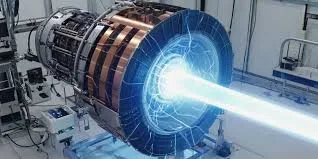
Russian scientists at Rosatom’s Troitsk Institute have developed a laboratory prototype of a high-power plasma electric rocket engine, capable of accelerating charged particles to
100 km/s using a magnetic plasma accelerator. This engine, designed for deep space, aims to reduce Earth-to-Mars travel time to 30–60 days, with a flight-ready model planned by 2030.
Key aspects of the Russian plasma engine include:
- Performance: The engine operates at 300 kW and produces roughly 6 Newtons of thrust, designed to operate in a pulse-periodic mode.
- Technology: It utilizes a magnetic plasma accelerator, differing from traditional chemical rockets by using electrical energy to move plasma, which significantly boosts fuel efficiency.
- Fuel and Power: The system uses hydrogen as propellant and is designed to be paired with a compact nuclear power source.
- Development Status: A prototype has been built and tested by scientists, including Egor Biriulin, at the Rosatom-associated TRINITI institute (Troitsk Institute of Innovative and Thermonuclear Research).
This technology is intended for interplanetary missions, significantly reducing astronaut exposure to cosmic radiation by shortening travel time compared to the nearly one-year duration of conventional engines.
From: Internet