What is ISRO project preparation of Gaganyaan mission ?

The ISRO Gaganyaan mission is India’s first human spaceflight program, aiming to send a crew of three astronauts into a 400 km orbit for a 3-day mission and return them safely to Earth. Preparations involve developing critical technologies, conducting unmanned test flights, and training astronauts. The first uncrewed test flight is targeted for the fourth quarter of 2025, … Read more

Is quantum physics related to cosmology or astrophysics? If related then how? How it relate to cosmic order ?

61 Pg7d45jl. Sy466

Yes, quantum physics is closely related to both cosmology and astrophysics. Here’s how they are interconnected:

Quantum Physics and Cosmology

  1. Early Universe Conditions: Cosmology studies the universe’s origin, evolution, and large-scale structures. Quantum physics is essential for understanding the conditions of the early universe, particularly during the Big Bang. Quantum fluctuations in the very early universe can lead to the formation of structures like galaxies.
  2. Quantum Gravity: One of the major unsolved problems in physics is the reconciliation of general relativity (which describes gravity on large scales) with quantum mechanics. Theories of quantum gravity, such as string theory or loop quantum gravity, aim to describe how gravity behaves at quantum scales, which is crucial for understanding phenomena like black holes and the Big Bang.
  3. Inflationary Theory: Quantum mechanics plays a key role in inflationary cosmology, which posits a rapid expansion of the universe shortly after the Big Bang. Quantum fields are thought to drive this inflation, and fluctuations in these fields can lead to the observed large-scale structure of the universe.

Quantum Physics and Astrophysics

  1. Stellar Processes: Astrophysics involves the study of stars, galaxies, and other celestial bodies. Quantum mechanics is fundamental in explaining processes in stars, such as nuclear fusion. The behavior of particles at quantum levels determines how elements are formed in stellar interiors.
  2. Black Hole Thermodynamics: Quantum effects are crucial in understanding black holes. Concepts such as Hawking radiation, which suggests black holes can emit radiation due to quantum effects near their event horizons, highlight the interplay between quantum physics and astrophysics.
  3. Dark Matter and Dark Energy: Some theories about dark matter and dark energy involve quantum fields. Understanding these phenomena may require insights from quantum physics, particularly in how they interact with visible matter.

Summary

In summary, quantum physics provides essential insights into the fundamental processes governing the universe and its large-scale structures, making it a vital component of both cosmology and astrophysics. The interplay between these fields continues to be an active area of research, with many questions still to be answered.

Quantum physics and cosmic order are related through quantum cosmology, which is the application of quantum theory to the universe: 

  • Quantum cosmology-Quantum cosmology is the idea that quantum physics can be applied to the entire universe. It’s an attempt to develop a quantum theory of the universe that can answer questions about the universe’s first phases. 
  • Quantum and cosmic connection-The connection between the quantum and cosmic scales is what makes it possible to understand the universe. Without quantum physics, the universe would have been perfectly smooth, and it would have taken billions of years for stars and galaxies to form. 
  • Quantum gravity-A theory of quantum gravity that combines quantum theory and Einstein’s theory of relativity could smooth out gaps in space-time. This could restore determinism and convert the Big Bang into a “Big Bounce”. 
  • Cosmic microwave background-The cosmic microwave background (CMB) is the leftover glow from the Big Bang. The CMB shows that radiation from all directions has almost the same temperature, but there are slight imperfections. These imperfections correspond to regions of greater or lesser density than average. 

What is Friction in terms of Physics ? Explain in details.

friction

Friction: The Force that Resists Motion
Friction is a force that opposes the relative motion between two surfaces in contact. It arises from the interactions between the molecules of the contacting surfaces. When two surfaces try to slide past each other, these interactions create a resistance to the motion.
Types of Friction
There are several types of friction, each with its own characteristics:

  • Static Friction:
  • Occurs between two surfaces at rest relative to each other.
  • Prevents the object from starting to move.
  • Its magnitude increases as the applied force increases, up to a maximum value.
  • Kinetic Friction:
  • Occurs between two surfaces in relative motion.
  • Opposes the motion of the object.
  • Its magnitude is generally constant and less than the maximum static friction.
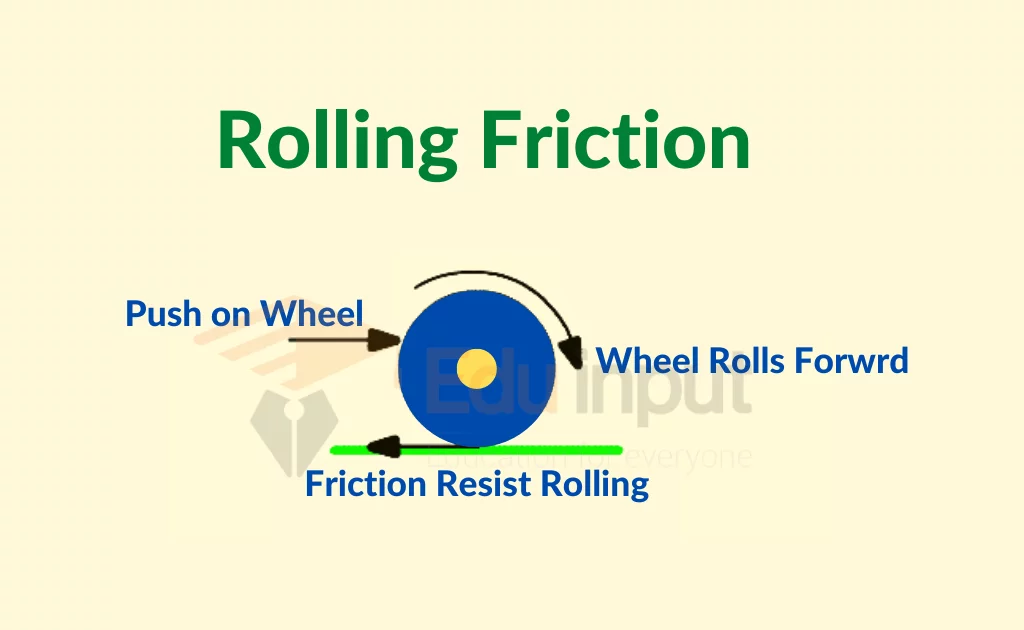
  • Rolling Friction:
  • Occurs when a round object rolls over a surface.
  • Much smaller than sliding friction.
  • This is why wheels and ball bearings are used to reduce friction.
  • Fluid Friction:
  • Occurs between a fluid (liquid or gas) and a solid surface.
  • Also known as drag or viscous friction.
  • Its magnitude depends on the velocity of the object and the properties of the fluid.
    Factors Affecting Friction
    The magnitude of friction depends on several factors:
  • Nature of the surfaces: Rougher surfaces generally have higher friction than smoother surfaces.
  • Normal force: The force perpendicular to the surfaces in contact. Greater normal force leads to greater friction.
  • Area of contact: In most cases, the area of contact has little effect on friction.
  • Presence of lubricants: Lubricants reduce friction by creating a thin film between the surfaces.
    Importance of Friction
    Friction is both a friend and a foe. It can be beneficial or detrimental depending on the situation:
  • Benefits:
  • Enables us to walk, drive, and grip objects.
  • Allows us to light a match.
  • Helps in the operation of brakes and clutches.
  • Drawbacks:
  • Wears down moving parts in machines.
  • Generates heat, which can be wasteful.
  • Increases energy consumption.
    Reducing Friction
    To reduce friction, we can:
  • Use lubricants.
  • Make surfaces smoother.
  • Use ball bearings or rollers.
  • Streamline objects to reduce fluid friction.
    By understanding friction, we can control it to our advantage and minimize its negative effects.

What is Tension in terms of Physics ? Describe with examples.

tension

Tension in Physics
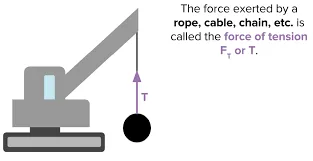
Tension is a pulling force transmitted axially by a rope, string, chain, or similar object. It’s a force that acts along the length of the object, stretching or pulling it apart. In essence, tension is the opposite of compression.
Examples of Tension:

  • A Hanging Object:
  • When you hang a weight from a rope, the rope experiences tension. The weight pulls downward, and the rope pulls upward to support it. The tension in the rope is equal to the weight of the object.
  • Tug-of-War:
  • In a tug-of-war, both teams pull on the rope with equal force. The rope experiences tension as it’s stretched between the two teams. The tension in the rope is equal to the force exerted by either team.
  • A Suspended Bridge:
  • The cables of a suspension bridge experience tension as they support the weight of the bridge and the traffic on it. The tension in the cables is distributed throughout the structure, ensuring its stability.
  • A Guitar String:
  • When you pluck a guitar string, it vibrates. The tension in the string is what allows it to vibrate and produce sound. The tighter the string, the higher the pitch of the sound.
    Key Points to Remember:
  • Tension is a pulling force, not a pushing force.
  • Tension acts along the length of an object.
  • The tension in a rope or string can vary depending on the weight it’s supporting or the forces acting on it.
  • Tension is a crucial concept in many areas of physics, including mechanics, statics, and dynamics.
    Visual Representation:
    By understanding tension, we can analyze and solve various problems involving forces and motion.